

Gist: Whilst corporate reports herald AI's transformative potential in education, peer-reviewed research reveals significant gaps between promotional narratives and the realities facing PGCE trainees entering increasingly AI-influenced classrooms.
After an intense two weeks my PGCE Computing students are about to embark on the first teaching experience. The days are long with lectures running all day and seeing my face throughout. On Thursday we cover AI in education, specifically focusing on Computing education are pre-university level. Exploration of both teacher and student possibilities, the good, the bad, and the ugly. Classroom teachers are facing unprecedented times with the AI4Edu drive talking about AI educational enhanced practices and performance. We explored lesson planning AI generation tools to coding support, through to explainer video generation. All under the umbrella of pedagogical and ethical use
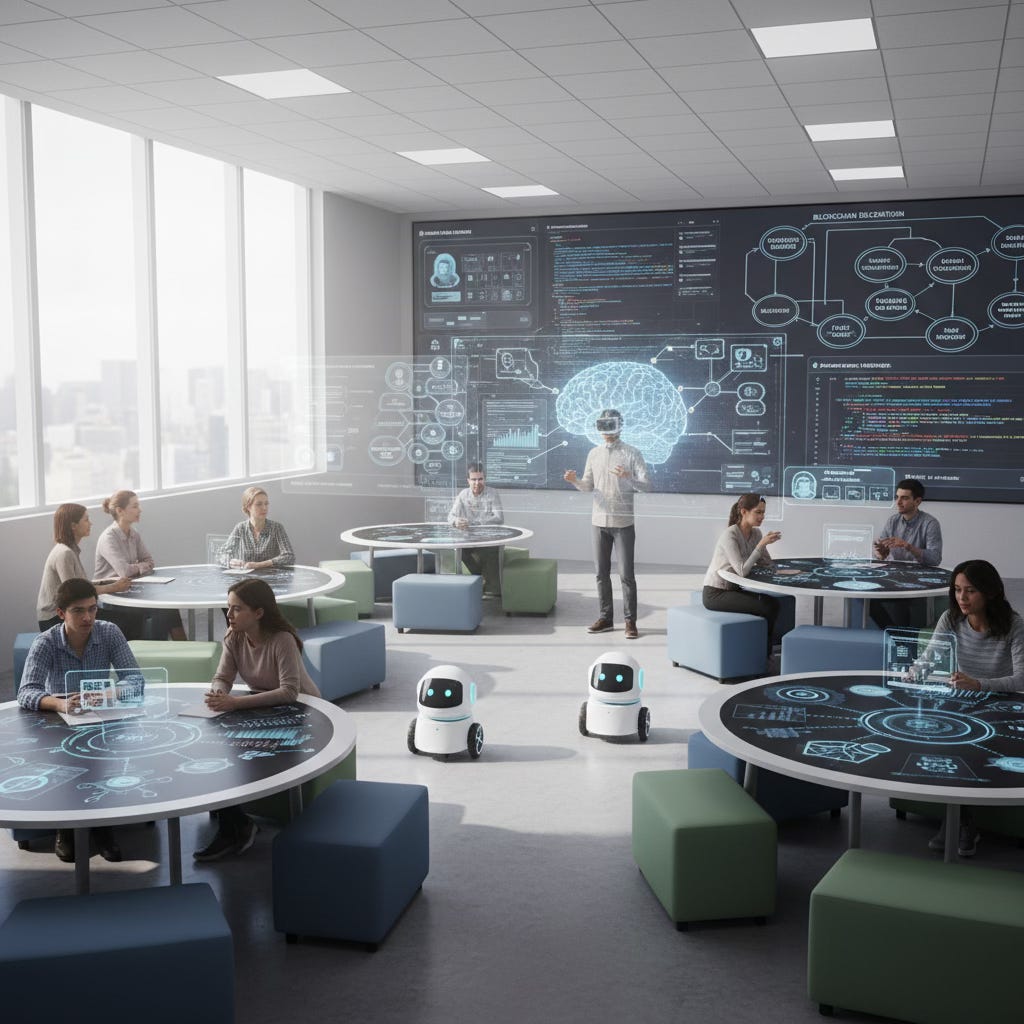
There's something profoundly unsettling about reading Microsoft's 2025 AI in Education Report alongside examining recent peer-reviewed research on teacher preparation programmes. The corporate narrative speaks eloquently of ‘AI-enhanced pedagogical practices’ and ‘transformative learning experiences,’ yet academic literature reveals that most teacher education programmes remain fundamentally unprepared for the AI integration they're supposedly facilitating.
This disconnect isn't merely anecdotal frustration. It represents a fundamental misalignment between the narratives of educational transformation being promoted by technology companies and the evidence-based realities facing those charged with implementing these changes: our trainee teachers.
The Evidence Base: What Research Actually Shows
Recent systematic reviews paint a concerning picture of the current state of AI integration in teacher preparation. by Zomer (2024), the datafication of student engagement and rights, found that engagement data is track and monitor but that educator didn’t find this data useful. These systems collect, collate, and analyse this data but what is done with that data afterwards. The author goes on to say that the students themselves should be given agency over this data. We had similar discussions about this on Thursday, the role of student data, AI tools, and their pedagogical practice.
A comprehensive analysis by Tan et al., (2025), found that while 65% of educational AI research focuses on student learning applications, only 35% addresses teacher professional development needs, highlighting a significant gap in research addressing how educators should be prepared for AI integration. This research deficit becomes particularly acute when we consider that the review emphasises the need for future research to focus on the development needs of teachers as they integrate AI technologies into their teaching practices. The current research landscape indicates that studies on AI in teacher professional development lag behind the practical needs of teachers seeking to integrate AI technologies in their teaching practices. (p16)
The situation is further complicated by findings from recent RAND Corporation research (Diliberti et al., 2025), which demonstrates significant inequality in AI training provision. According to district reports, low-poverty districts continue to outpace their higher-poverty counterparts in training teachers on AI use (Diliberti et al., 2025). This suggests that even where AI training exists, it's unevenly distributed, creating additional challenges for teacher preparation programmes serving diverse student populations.
The PGCE Challenge: Institutional Lag in Teacher Preparation
The most recent research specifically examining pre-service teacher preparation reveals concerning gaps between what trainee teachers need and what they're receiving. A 2025 study by Kohnke and colleagues found that the rapid transformation of educational practice by artificial intelligence requires that teacher-education programmes prepare pre-service teachers for AI-enhanced classrooms, yet most programmes have failed to systematically integrate such preparation. They close with this point which was similar to Thursday’s reflections,‘study reveals that pre-service teachers recognise the potential of AI in education but face significant challenges in developing AI literacy.’
This institutional lag isn't simply a matter of slow curriculum revision. Karataş (2024)’s study examined curriculum adaptation patterns found that AI, specifically ChatGPT, continues to be integrated into educational settings, transforming how curriculum adaptation is approached, offering tailored solutions that cater to diverse learning environments. However, this transformation is occurring primarily in schools rather than in the teacher preparation programmes that should be leading such changes.
The challenge becomes particularly acute when we consider that PGCE programmes operate within complex regulatory frameworks. The ITT-ECF (Initial Teacher Training & Early Career Framework), which define competency requirements for beginning teachers, make no explicit reference to AI literacy or digital tool integration beyond broad statements about using technology ‘effectively.’ This regulatory silence creates institutional inertia—why would PGCE providers invest significant curriculum space in AI education when it's not formally assessed or required? Though it is vital that it is covered due to the nature of use of AI by future students.
The Training Gap: Evidence from Professional Development Research
Whilst PGCE programmes may struggle with integration, research on in-service professional development provides insights into effective approaches that could inform pre-service preparation. A recent study by Ding et al. (2024) examined case-based AI professional development programmes and found that the AI PD program aimed to stimulate teachers' understanding of AI integration strategies and enhance their AI literacy through different types of cases. This research suggests that effective AI preparation requires structured, case-based approaches rather than theoretical overviews.
However, systematic reviews of teacher AI training challenges reveal significant obstacles. Research by Aljemely. (2024) identified that trainers face challenges while training teachers to use artificial intelligence, including technological infrastructure limitations, varying levels of teacher digital literacy, and resistance to pedagogical change. These challenges become amplified in PGCE computing contexts where trainees are simultaneously developing fundamental teaching skills and rapid technological advancements
The Authenticity Problem: Research Versus Reality
Perhaps more concerning than the skills gap is what research reveals about the authenticity problem in AI integration. Studies examining teacher perceptions consistently show that whilst educators acknowledge AI's potential benefits, they express significant concerns about implementation realities. Recent research by Gârdan et al. (2024) found that teachers acknowledge AI potential to enhance educational outcomes and streamline teaching processes, considering important to be addressed at the same time their concerns about practical implementation challenges.
This creates a problematic disconnect for PGCE students. Corporate reports and promotional materials emphasise polished case studies from well-resourced schools with dedicated IT support and extensive teacher training. However, research consistently shows that such exemplars bear little resemblance to the placement experiences of most trainee teachers, who find themselves in schools where basic technology infrastructure remains inconsistent.
UK Policy Context: The Implementation Challenge
Recent UK government initiatives provide important context for understanding the challenges facing PGCE programmes. In August 2024, the DfE announced a £4 million investment to develop a set of AI tools for different ages and subjects to help manage the burden on teachers for marking and assessment. However, this policy focus on tool development rather than teacher preparation highlights the disconnect between technological provision and pedagogical readiness.
Government research on early AI adopters in schools reveals this tension clearly. Research conducted through 21 interviews with schools, FE colleges and multi-academy trust leaders who have been embedding and using AI for at least 12 months shows successful implementation requires sustained leadership commitment and systematic professional development—precisely the elements typically absent from initial teacher preparation.
Implications for PGCE Programme Design
The research evidence suggests several critical implications for PGCE programme design. Rather than focusing on specific AI tools that may become obsolete, programmes need to develop what the literature increasingly terms ‘AI literacy’–the capacity to understand, evaluate, and thoughtfully integrate AI tools within pedagogical frameworks.
This approach aligns with findings from systematic reviews suggesting that effective AI integration requires understanding of both technological capabilities and pedagogical principles. The research indicates that successful programmes combine technical skill development with critical evaluation capacities, enabling teachers to make informed decisions about when and how AI tools support learning objectives.
However, the evidence also suggests that such integration cannot be superficial. Studies consistently show that meaningful AI literacy development requires sustained engagement with authentic teaching contexts—precisely what makes integration challenging within time-constrained PGCE programmes.
Research Limitations and Future Directions
It's important to acknowledge that the current research base has significant limitations. Most studies focus on in-service rather than pre-service contexts, and there's limited research specifically examining PGCE programmes in England. Additionally, the rapid pace of AI development means that research findings may quickly become outdated.
Nevertheless, the available evidence provides clear guidance for teacher preparation programmes. The research consistently emphasises that effective AI integration requires systematic preparation, pedagogically-grounded approaches, and sustained support—elements that require fundamental changes to how PGCE programmes conceptualise and deliver teacher preparation.
Looking Forward: Evidence-Based Approaches to Change
The research evidence suggests that the transformation of teacher education won't be driven by corporate reports or technological capabilities alone—it will require systematic, evidence-based approaches to curriculum integration. This means developing teacher educators' own AI literacy, creating authentic integration experiences within PGCE programmes, and establishing partnerships with schools already engaging thoughtfully with AI tools.
Most importantly, the evidence suggests that successful integration maintains focus on fundamental pedagogical principles whilst developing critical evaluation capacities. The research indicates that well-prepared teachers understand both the potential and limitations of AI tools, can evaluate their appropriateness for specific learning contexts, and can adapt thoughtfully to technological change without losing sight of core educational purposes.
The challenge for PGCE programmes and my students isn't simply adding AI content to existing curricula. It's fundamentally reconceptualising teacher preparation for an increasingly AI-influenced educational landscape whilst maintaining the pedagogical foundations that effective teaching requires.
What does the research evidence suggest about effective approaches to AI integration in your context? How can teacher preparation programmes better bridge the gap between corporate promises and classroom realities? The evidence base is growing, but we need more research specifically examining pre-service teacher preparation to inform these critical decisions.